
The Complete Guide to Tablet Buyback Value (2026)
Enterprise tablet fleets lose roughly 38% of their resale value in the first year and over half by year two. For organizations managing hundreds or thousands of enterprise device buyback units, that depreciation curve turns every month of inaction into measurable budget loss.
The problem is not the hardware. The problem is the absence of a structured valuation and recovery process that matches the pace at which tablets depreciate.
This guide covers every stage of tablet buyback value tracking for large-scale programs. You will find the valuation factors that determine what your fleet is actually worth, the inspection and grading workflows that protect recovery rates, the data-wiping standards that satisfy auditors, and the reporting frameworks that give IT asset management leaders the numbers they need to justify the program internally.
Refreshed Tech handles this end-to-end from its 103,000 sq ft facility in Ashley, Indiana, where it has bought, wiped, and refurbished devices for schools and enterprises since 2018 as a Microsoft Authorized Refurbisher. The operational specifics throughout this guide reflect what that kind of process discipline looks like in practice.
Key takeaways
- Tablet resale values drop significantly each quarter, making timing the single largest lever for financial recovery.
- Structured valuation tied to model, storage, condition, and market demand produces more accurate and defensible quotes.
- Certified data wiping to NIST 800-88 protects compliance and unlocks resale without trading off security.
- Refreshed Tech provides serial-level inspection, certified destruction, and payment that lands before the final report does, with tablets averaging a 4–6 day turn.
- Reporting at the device level closes audit gaps and gives finance teams transparent recovery data for budget planning.
Why enterprise tablet fleets lose value faster than most teams realize
Tablets depreciate on a steeper curve than laptops. A working tablet typically loses around 38% of its original value in the first twelve months and roughly 52% by month twenty-four, based on typical secondary-market pricing trends. By year three, the figure approaches 68%.
The depreciation accelerates around two events. The first is a new model launch from the original manufacturer. When Apple or Samsung releases a new tablet generation, used models can drop 10 to 15% in resale value within weeks as trade-in inventory floods secondary channels.
The second trigger is a software support cutoff. A tablet that no longer receives the current operating system loses access to applications, security patches, and buyer confidence simultaneously.
For IT asset management leaders overseeing fleets of 500 to 5,000 tablets, every quarter of delayed disposition compounds that loss across every unit. The financial difference between selling six months before a new-model announcement and six months after can exceed $100 per device.
Across a 1,000-unit fleet, that timing gap represents a six-figure swing in recovered capital.
What drives tablet buyback value at enterprise scale?
Model, storage, and specification. The single largest factor in buyback value is the combination of model and storage capacity. An iPad Pro with an M-series chip and 256 GB of storage commands a materially different price than a base iPad with 64 GB. The same applies to Samsung Galaxy Tab S-series versus the A-series, and Surface Pro versus Surface Go.
Storage matters more on tablets than on most other device categories because tablets rarely support external storage expansion in enterprise configurations. Buyers filter by storage tier, and the pricing gap between tiers is measurable. Standardizing on higher-storage configurations benefits you during active use and at disposition.
Cosmetic condition and functional status. Cosmetic grading follows a standard rubric. Grade A devices show minimal visible wear. Grade B devices have light scratches invisible when the screen is on. Grade C units show noticeable marks but remain fully functional. Grade D devices carry heavy wear or disclosed functional issues.
The financial spread between Grade A and Grade C on a popular tablet model can range from $40 to $80 per unit. That gap widens on newer, higher-value models. IT teams that issue protective cases and enforce handling policies during deployment tend to recover that investment at disposition through higher grade classifications.
Battery health. Battery capacity is now visible to buyers on most platforms. iPadOS displays battery health as a percentage, and buyers negotiate against it. A tablet at 95% maximum capacity sells for materially more than one at 80%.
Across a fleet, battery degradation patterns are not random. Devices used for intensive applications drain faster, and tablets stored without periodic charging develop capacity issues.
Tracking battery health at the fleet level before initiating a buyback helps predict per-unit value and reduces surprises at inspection.
MDM and activation lock status. A tablet still enrolled in Mobile Device Management, Apple Business Manager, or tied to a Google account is worth significantly less than a clean unit. In some cases, a locked device cannot be resold at all.
Deprovision workflows need to happen before devices ship for buyback. IT teams that build this step into the refresh timeline avoid last-minute scrambles that delay the entire process.
How tablet depreciation compares across operating systems
iPads hold value more effectively than Android tablets on the secondary market. A two-year-old iPad Pro typically retains 60 to 70% of its original value, while a Samsung Galaxy Tab S-series unit of the same age retains roughly 40 to 50%.
The difference comes from three factors: Apple's extended software support window of six to eight years, ecosystem lock-in through accessories and applications, and stronger buyer perception of long-term durability.
Microsoft Surface Pro devices behave more like laptops than tablets on the resale market because they run full Windows. Their depreciation curve sits between iPads and Android slates, with Surface Pro models retaining $400 to $700 in resale value two to three years after purchase depending on configuration.
For mixed-fleet environments, the buyback strategy should not be one-size-fits-all. iPad-heavy fleets can afford a slightly longer hold before disposition. Android-heavy fleets benefit from faster turnover, ideally within eighteen to twenty-four months of deployment.
A buyback partner that quotes by model and operating system rather than by lot gives you the granularity to make that distinction.
Step by step: how a structured tablet buyback program works
Step 1: Fleet inventory and asset list preparation. The process starts with a clean inventory. IT teams compile a device list that includes make, model, storage capacity, serial number, known cosmetic issues, and lock status. Accuracy at this stage directly affects quote accuracy downstream.
Asset management systems that maintain serial-level records simplify this step. Organizations relying on spreadsheets should reconcile assigned devices against physical inventory before requesting quotes. Refreshed Tech accepts a CSV, a Google Admin (GAM) export, or even a rough model mix to get started.
Step 2: Valuation and quote. A capable buyback partner returns an itemized quote, broken out by model, storage tier, and estimated grade. Refreshed Tech provides quotes within one business day, priced per model and condition. Itemized quoting matters because it lets your finance team see exactly where value is coming from and where condition or model-mix gaps reduce recovery.
Step 3: Device preparation and lock removal. Before shipping, deprovision every device from MDM, Apple Business Manager, Apple School Manager, Google Admin, and any activation lock. Remove SIM cards if applicable. This preparation step affects both security posture and resale value. A single locked unit in a shipment of 200 can delay processing for the entire batch.
Step 4: Logistics and secure transit. Packaging and chain of custody matter more for tablets than for most device categories. Tablets are thinner, screens crack more easily in transit, and cosmetic damage during shipping directly reduces the final settlement.
A partner that provides packing kits with prepaid return labels, shipped the same day you accept the quote, removes the logistical burden from your IT team. For larger fleets, on-site pickup with crew-managed palletization is the more reliable path. Refreshed Tech covers shipping nationwide and, for larger lots, sends its own crew to pack on your dock.
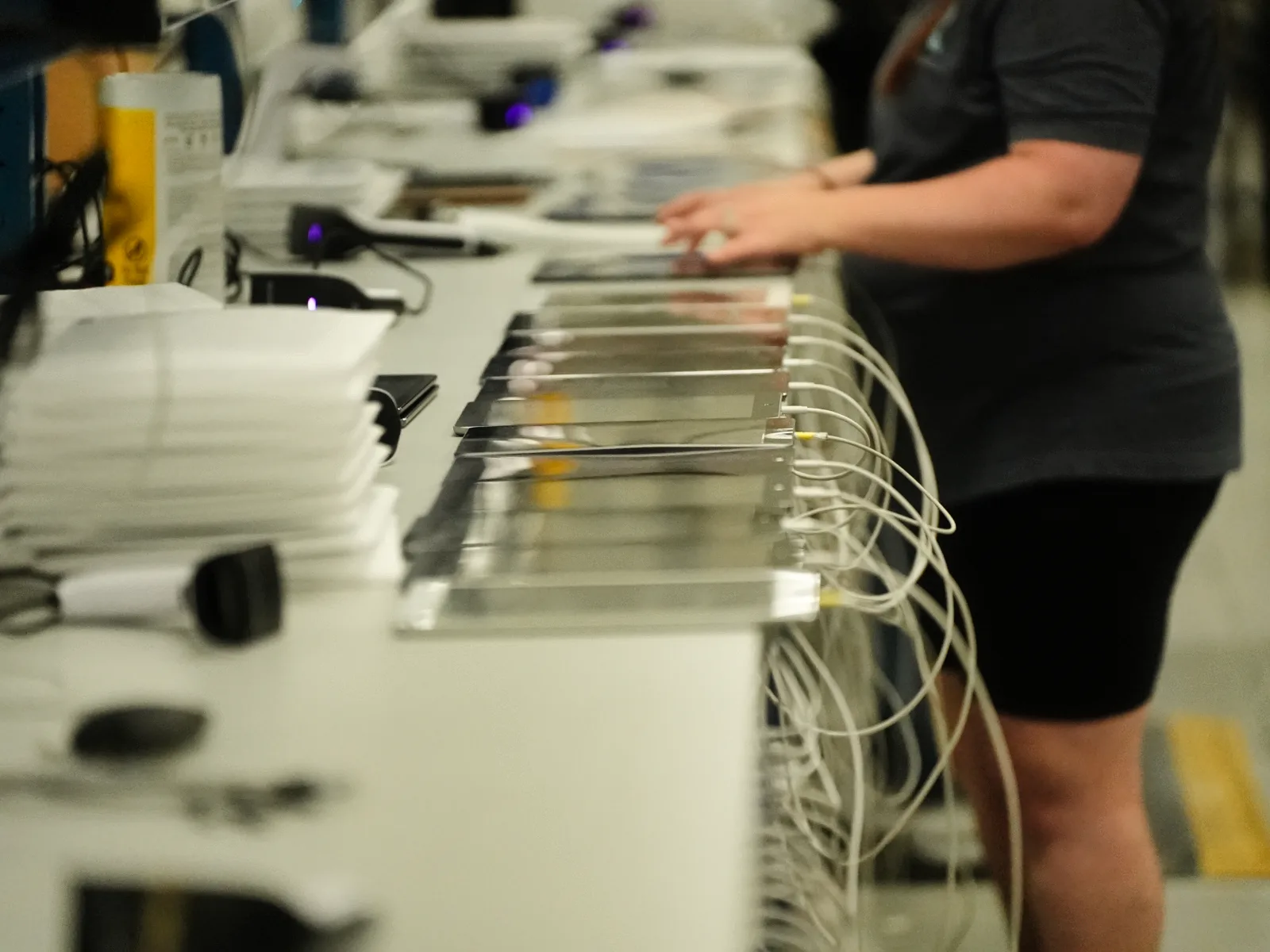
Step 5: Inspection, grading, and data destruction. At intake, each tablet is serial-tracked, visually inspected, functionally tested, and graded against a fixed rubric. Storage, processor, battery, screen, and body condition are all verified against the original asset list.
Any discrepancy between the quoted grade and the inspected grade is documented at the serial level. The partner should communicate the adjustment before issuing a revised offer.
Data destruction follows inspection. NIST 800-88 sanitization is the standard that satisfies most audit requirements for enterprise and education environments. Devices that cannot be purged go through certified physical destruction. The output is a serial-tracked Certificate of Data Destruction tied to every device in the shipment.
Step 6: Payout and reporting. Payment should land promptly after inspection closes, with a clear settlement report. Refreshed Tech pays via ACH, check, store credit, or gift card, and final payment arrives before the report does. The serial-level inspection report and Certificate of Data Destruction arrive together in the same email. That documentation package is what your compliance team, your finance team, and your auditors need to close the loop.
Why certified data wiping is non-negotiable for tablet buyback
Tablets store more sensitive data than most organizations realize. Email accounts, cached credentials, VPN configurations, internal documents, and regulated records in healthcare and education environments all persist unless properly sanitized.
A factory reset is not sufficient. It does not sanitize all storage areas, and it leaves no verifiable record for a specific device.
NIST SP 800-88 provides a framework with three levels: Clear, Purge, and Destroy. For tablets leaving an organization through buyback, Purge is the standard. It uses firmware-level commands or cryptographic erase to render data irrecoverable even with advanced lab techniques, while keeping the device functional for resale.
The documentation is what transfers liability. A Certificate of Data Destruction tied to specific serial numbers is what you hand to an auditor, a compliance officer, or a state reviewer. A certificate that covers a batch in aggregate without serial-level detail is much weaker evidence.
According to a 2024 report from the UN Global E-waste Monitor, 62 million tonnes of e-waste were generated globally in 2022, with less than a quarter properly collected and recycled. Keeping functional tablets in circulation through a buyback program with verified data destruction is both the more secure and the more environmentally accountable path.
Inspection and grading workflows that protect recovery rates
Grading consistency is the difference between a quote you can plan against and a payout that surprises finance. When every tablet in a shipment is graded by a human against a fixed, published rubric, the variance between quoted and final value drops.
At Refreshed Tech, a real person in Ashley grades every tablet against the same published rubric, and any change from the quoted grade is documented at the serial level during inspection. That consistency comes from standardization.
Every device follows the same path: serial intake, cosmetic inspection, functional test, battery verification, lock-status confirmation, and data sanitization. The rubric defines what Grade A, B, C, and D look like on each device category, and the definitions are shared with the seller before the first device ships.
For IT teams, the takeaway is practical. If you know the grading rubric in advance, you can pre-sort your fleet and set more accurate internal recovery expectations. That alignment between your estimate and the partner's final grade reduces friction, accelerates settlement, and makes the next buyback cycle easier to plan.
How retrieval logistics affect tablet buyback value
Logistics is where value leaks if the process is not tight. Tablets are fragile relative to laptops. Cracked screens, pressure marks, and bent chassis from poor packaging can drop a Grade A device to Grade C or worse. That downgrade costs $40 to $80 per unit in recovered value.
For centralized fleets stored in a single warehouse or office, the fix is straightforward: use purpose-built packing materials and ship in padded, right-sized containers.
For distributed fleets with tablets scattered across remote offices or field employees, the complexity increases. Serialized return kits with custom-printed packaging, prepaid return labels, and a packing checklist in the box provide a controlled path for individual returns.
Refreshed Tech handles both models. Centralized pickups are crew-managed from your dock. Distributed returns use kitted shipping with prepaid labels and tracked transit. Either way, chain-of-custody documentation runs from the moment the device leaves your facility to the moment it enters the processing line.
Reporting frameworks for enterprise tablet buyback programs
The financial report is not the only deliverable that matters. A complete buyback reporting package should include serial-level asset reports listing every processed device with model, grade, and disposition outcome. It should also include a Certificate of Data Destruction with serial numbers, sanitization method, and date.
A value breakdown showing what each model and grade tier contributed to the total payout rounds out the financial picture. For organizations with sustainability goals, a carbon-impact report quantifying reuse outcomes adds weight to ESG reporting. Refreshed Tech provides a monthly carbon report, and in 2025 its partners' surplus devices kept 149,571,180 lbs of CO₂ out of the atmosphere.
This documentation solves three problems. First, it gives finance a transparent view of where recovered dollars came from. Second, it gives compliance an audit trail that satisfies HIPAA, FERPA, GDPR, and SOX requirements depending on your industry.
Third, it gives leadership a data set to benchmark against future refresh cycles, so each program improves on the last.
Device-level reporting is not optional for serious programs. Aggregate tonnage reports do not tell you which devices were resold and which were recycled. They do not tell you whether your fleet's average grade improved from one cycle to the next. That granularity is what separates a managed asset recovery program from a one-time cleanout.
Common mistakes that reduce tablet buyback recovery
- Waiting too long to sell. The most common mistake is also the most expensive. Tablets parked in storage closets lose value on a predictable curve, and every month of delay compounds across every unit. Plan buyback as part of the refresh cycle, not as a cleanup task months after new devices arrive.
- Skipping lock removal. Devices still enrolled in MDM, iCloud, or Google accounts create processing delays and reduce payout. In some cases, locked devices cannot be resold at all. Build deprovisioning into the offboarding or refresh workflow before devices ship.
- Sending inaccurate asset lists. A mismatch between your quoted device list and the actual shipment leads to re-grading, revised offers, and settlement delays. Reconcile your records against physical inventory before requesting a quote.
- Ignoring packaging quality. Tablets shipped in loose boxes without protective inserts arrive damaged. That damage drops grades and costs you money. Use kitted packaging from your buyback partner or invest in anti-static wrap and foam inserts.
- Choosing a partner based on payout alone. The quoted payout number matters, but it means less without serial-level documentation, certified data destruction, and a transparent grading process. A higher quote from a partner that cannot produce a Certificate of Data Destruction is not a better deal. It is an unverified promise.
How to build tablet buyback into your device lifecycle management strategy
Tablet buyback works when it is planned from procurement forward, not bolted on at end of life. That means capturing the data that matters at purchase: vendor terms, buyback agreements, warranty details, and model standardization choices. It means tracking condition throughout deployment, not discovering battery failures and cracked screens for the first time at disposition.
Here is a practical framework for integrating buyback into your device lifecycle management program:
- At procurement. Select tablet models with strong secondary-market demand. Standardize on fewer configurations to enable batch processing at disposition. Negotiate vendor buyback clauses where available.
- During deployment. Issue protective cases. Track battery health, repair history, and cosmetic condition in your asset management system. Keep serial records current.
- At refresh trigger. Initiate buyback planning as soon as the refresh is approved, not after new devices arrive. Request quotes while the fleet is still in use so the timeline is locked before values shift.
- Post-buyback. Review the serial-level settlement report against your pre-buyback estimate. Identify where condition or lock-status issues reduced recovery. Use those findings to tighten deployment policies for the next cycle.
This loop turns buyback from a reactive cleanup into a predictable financial recovery channel. Over two or three refresh cycles, the data compounds. You learn which models hold value, which deployment practices protect condition, and which timing windows maximize payout.
How to maximize tablet buyback value across your fleet
Tablet buyback value is not fixed at the moment you decide to sell. It is shaped by every decision from procurement through disposition: which models you buy, how you protect them during deployment, when you initiate the buyback, and who you trust with the inspection and data destruction.
For IT asset management leaders running large-scale programs, the operational fundamentals are clear. Sell sooner rather than later. Remove locks before shipping. Send accurate asset lists. Choose a partner that provides serial-level grading, NIST 800-88 sanitization, and transparent reporting.
Refreshed Tech runs that process from a 103,000 sq ft facility in Ashley, Indiana, with serialized inspection, certified data destruction, and documentation built for auditors, for school districts and enterprises alike. Request a quote within one business day and put a number on your fleet before the next depreciation cycle takes it. Prefer to talk it through? Call (260) 344-6646.
FAQ
What factors determine how much an enterprise tablet fleet is worth? Tablet buyback value depends on model, storage capacity, cosmetic condition, battery health, lock status, and current secondary-market demand. Newer tablets with higher storage and clean activation status recover the most value. Refreshed Tech quotes each device by model and grade, so you see exactly where recovery comes from.
How quickly do tablets lose resale value after deployment? Tablets typically lose around 38% of their original value in the first year and roughly 52% by year two. New model launches and software support cutoffs accelerate the decline. Selling within eighteen to twenty-four months of deployment captures the strongest recovery window for most enterprise fleets.
What data destruction standard should a tablet buyback partner follow? NIST SP 800-88 is the benchmark for enterprise and education environments. It defines three levels of sanitization: Clear, Purge, and Destroy. Refreshed Tech sanitizes every tablet to NIST 800-88 and delivers a serial-tracked Certificate of Data Destruction, giving your compliance team the documentation auditors require.
Do iPads hold resale value differently than Android tablets? iPads retain significantly more value over time. A two-year-old iPad Pro typically holds 60 to 70% of its original price, while a comparable Android tablet holds 40 to 50%. Apple's longer software support and stronger secondary-market demand are the primary drivers of that gap.
How can IT teams increase the value they recover from a tablet buyback? Sell sooner rather than later, remove all MDM and activation locks before shipping, issue protective cases during deployment to preserve cosmetic grade, send accurate asset lists to avoid re-grading at inspection, and choose a partner like Refreshed Tech that provides itemized quotes and serial-level settlement reports so you can benchmark and improve each cycle.
Ready to put a number on your tablet fleet?
Get a Quote ↗